
From PET bottles to insulation: What's inside our underquilts
Part 3 of our series: An honest look at our sustainability decisions
In the last part of our series on materials, production, and the decisions behind them, we covered everything surrounding a product: packaging, or rather, as little of it as possible. This time we’re looking at what’s inside: the insulation in our underquilts.
If you’re wondering what an underquilt is and which of our models is right for you, we explain this in detail in this post.

What actually keeps you warm if not down?
For our Moonquilt Compact and Moonblanket Compact, we use Thermore® insulation called Ecodown, with a weight of 115 g/m². The fibers are made from 100% recycled polyester from PET bottles.
Ecodown was developed as a synthetic alternative to down and is also used in winter jackets and outdoor clothing. The material combines high warmth with low weight and contains absolutely no animal-derived down or feathers. These are also important qualities for our underquilts.
It is important to us to be precise: it is the insulation fibers that are made from 100% recycled material, not the entire underquilt. The outer fabric, sewing thread, and other components are not included. We do not want to promise more than what is actually there.
How a bottle becomes insulation
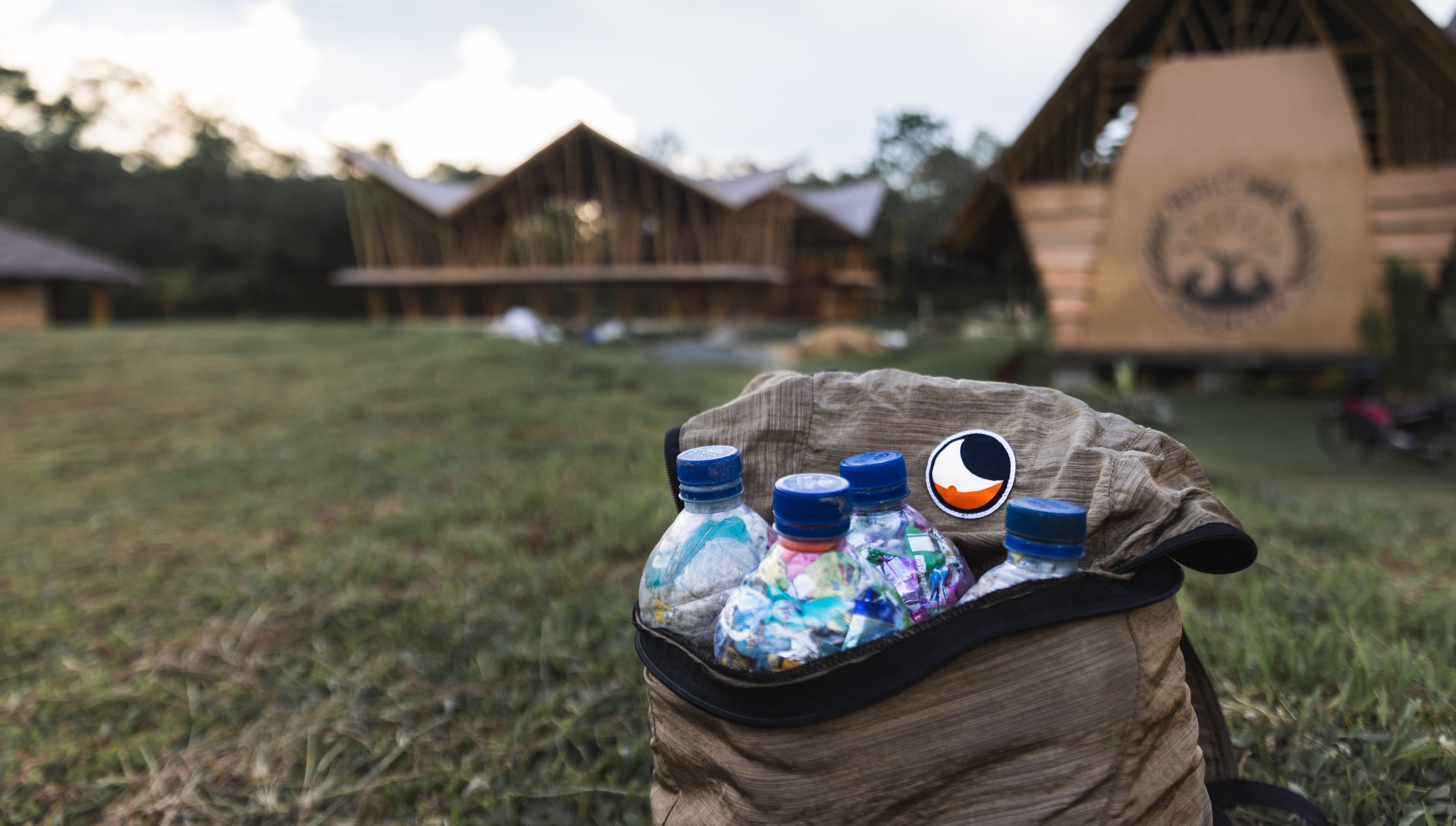
The process: used PET bottles are collected, sorted, cleaned, and processed into polyester fibers. These fibers are then made into a lightweight, warming insulation fleece – exactly what provides warmth in our underquilts without any down.
Thermore has Ecodown certified under the Global Recycled Standard (GRS), as well as OEKO-TEX® Standard 100 and bluesign®. For anyone who wants to read the details: thermore.com/en/product/ecodown
Why this actually makes a difference
The fact that PET is fundamentally recyclable does not mean that this happens everywhere. Recycling rates for PET bottles vary widely worldwide. While countries with deposit systems such as Germany or Norway achieve rates of over 95% in some cases, the global recycling rate for plastic bottles in 2020 was only 27.2%, according to the World Economic Forum.¹ A large proportion still ends up in landfills, is incinerated, or leaves the circular economy entirely. Every PET bottle that is instead processed into insulation fibers stays in the circular economy longer instead of becoming waste.

And to be completely honest: we do not use recycled fibers everywhere
Despite our enthusiasm for PET insulation, we do not want to pretend that this is the whole story. Our Moonquilt Pro models are filled with down, not recycled polyester. Down has properties that for certain requirements (such as the warmth-to-weight ratio) cannot yet be fully replaced by recycled synthetic material. That is why we continue to use it there.
This does not fit perfectly with a post that is actually about recycled material. And that is exactly what we want to be honest about. We make compromises here, as does probably every brand that deals honestly with the issue. What we can do within this framework: The down in the Moonquilts Pro is RDS-certified (Responsible Down Standard). Specifically, this means: no force-feeding, no live-plucking, and every stage of the supply chain – from the rearing farm to the finished product – is independently audited and traceable.²
RDS is primarily an animal welfare and traceability standard and says nothing about how resource-intensive down production is overall. However, it does mean that we meet clear, externally audited standards at least regarding the conditions under which the down is sourced – even if we are not yet where we would like to be in terms of recycled material.
Just one building block
Different materials for different requirements: some underquilts with insulation made from recycled PET bottles, others with RDS-certified down, because we cannot yet fully combine the two. That is exactly the point of this series: We do not want to claim that we have already found the perfect solution everywhere, but rather show what decisions are behind it and why we make them.
Insulation is just one of many building blocks. How and where we manufacture our products, from Bali to our European warehouse, is the next part of this series.
Sources
- World Economic Forum (2022): World recycling facts for 2022: Plastic, paper and more.
- Textile Exchange: Responsible Down Standard (RDS).
The RDS is a voluntary international standard for animal welfare in the duck and goose supply chain, as well as for the traceability of down and feathers from the certified facility to the final product. Individual sites are audited annually by independent certification bodies; live-plucking and force-feeding are prohibited.

Leave a comment
This site is protected by hCaptcha and the hCaptcha Privacy Policy and Terms of Service apply.