
EMPCO Guidelines and Product Information
Environmental and Social Statements from Ticket to the Moon (TTTM)
More Transparency for You—Why Our Sustainability Statements Are Changing.
Environmental and social claims made by TTTM and on TTTM products may reflect older labeling standards. You can find current and more detailed information in accordance with EU requirements (Empowering Consumers for the Green Transition: EmpCo) here.
What does this mean for products you buy or already own?
TTTM is updating its environmental communications in accordance with the new EU requirements (Empowering Consumers for the Green Transition: EmpCo). Products manufactured before September 1, 2026, may contain environmental and social claims that require further explanation under the new requirements. The necessary evidence for this was and remains available—what is new is the legal requirement for independent certification and specification directly on the product.
What's Changing and Why We're Providing This Page
The EU Directive on Empowering Consumers for the Green Transition (EmpCo) requires that, effective September 27, 2026, environmental and social claims be specific, verifiable, and independently verified.
General terms such as “sustainable,” “people- or tree-friendly,” “upcycled,” or “fairly produced” are no longer permitted without verifiable evidence—in both brick-and-mortar and online retail.
We are adopting a two-pronged approach here: Whenever possible, we will black out the relevant information. In cases where the entire hang tag or product label would need to be replaced, we will refrain from physically relabeling these products—which would amount to a waste of materials. That is why we are providing supplementary, clarifying information here. This approach is in line with the official recommendation of the European Commission (FAQ on the EmpCo Directive, Question 18).
Information About Warranties
Please note: The “10-year warranty” printed on the labels or packaging of these items is no longer valid. Only the standard 2-year legal warranty applies to these products. Exception: Hammocks made from standard and premium materials. These include:
- Compact Hammock
- Original Hammock
- King-Size Hammock
- Mini Hammock Set
- Honey Moon Hammock Set
- Mammock Hammock Set
- Junior Hammock Set
- Rainbow Hammock Set
- Pro Hammock
- Pro Mat Hammock
- Thermo Pro Hammock
- Home Hammocks
Past Statements—and What They Mean Today
Strikethrough text indicates the original product statements. Instead, you'll see the current, EmpCo-compliant version—or an explanation of why a statement has been omitted entirely.
Past Statements—and What They Mean Today
In accordance with the new EU directive (EmpCo), we have thoroughly reviewed our product descriptions, hangtags, and communication materials. Our goal is to provide you with maximum transparency and to replace vague marketing claims with verifiable facts.
Here is an overview of how we have either clarified or completely removed previous advertising claims:
1. More Specific StatementsPreviously: “PFC-free”
Now: “Free of fluorocarbons (PFAS/PFC) / Treated with Nikwax Hydrophobic Down®”
Why? The blanket term “PFC-free” can be misinterpreted as advertising that takes the obvious for granted, since many of these chemicals are already being phased out by law. Instead, we clearly state that we do not use controversial fluorocarbons in our down products (such as the Moonquilt or Moonblanket) and instead use the proven, high-performance, yet gentler Nikwax waterproofing treatment (NHD®).
Previously: “Fair Production” / “Fairly and Sustainably Produced”
Today: “WFTO Member (World Fair Trade Organization) / Own production facility in Bali”
Why? Terms like “fair” or “social” aren’t defined by law and are therefore subjective. We replace these vague terms with hard facts: Ticket to the Moon is a certified member of the WFTO. This means that our supply chain and our in-house factory in Bali undergo regular audits based on strict, internationally recognized fair trade standards.Previously: “Sustainably sourced down” / “Certified down”
Today: “RDS®-certified down (Responsible Down Standard)”
Why? We don’t just claim that our down is “sustainable.” We always explicitly cite the independent third-party standard. The Responsible Down Standard (RDS) guarantees that the down in our quilts and blankets comes exclusively from facilities that strictly adhere to animal welfare standards (no live plucking, no force-feeding).
Instead of: “Sustainability meets functionality—upcycling parachute fabric to reduce plastic waste.”
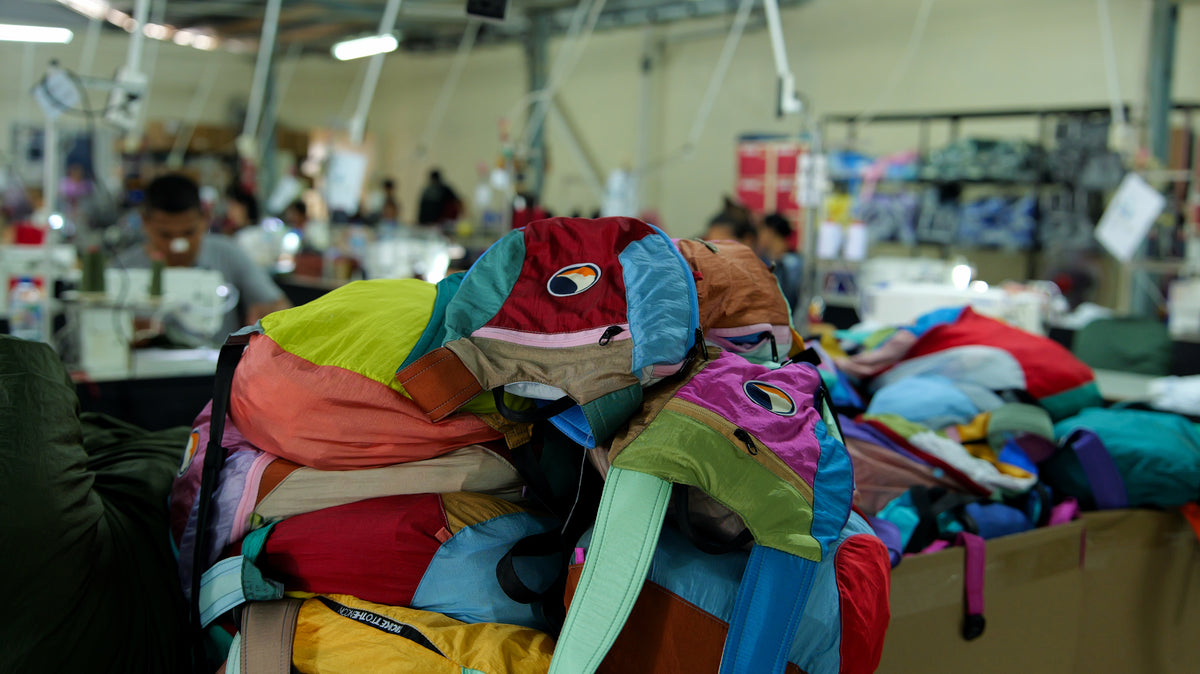
EmpCo-compliant: “Note on the Unique Color: Every product in our Unique Edition is a one-of-a-kind item. Our experienced seamstresses and tailors craft them with great attention to detail from the scrap materials (nylon offcuts) generated during the production of our hammocks.”
Previously: “Recycled 20D sil-nylon / recycled aluminum (e.g., in the carabiners), -90% CO2”
Today: “Made from 100% recycled polyamide (e.g., GRS-certified and Bluesign-certified)” / “90% recycled aluminum (GRS, v.4)”
Why? According to the new EU regulations, the term “recycled” on its own is considered imprecise and could lead to legal action. When consumers see “recycled material,” it must be clear: What exactly is the percentage of recycled content? And who verified it? That’s why we no longer use the term “recycled” on our products without providing context. If a material—such as the one used in our tarps—consists of processed raw materials, we either directly cite the underlying, independent certification (e.g., the Global Recycled Standard) along with the exact percentage, or—as with our bags made from fabric scraps—we describe, in a purely factual manner, exactly where the reused material comes from.
Previously: “PFC-free material”
Now: “No fluorocarbons (PFAS/PFC)”
Why? On some product pages, we have often advertised our fabrics as “PFC-free” in the same breath. Since many of these harmful chemicals are now banned under EU legislation (REACH) anyway, a blanket claim of “PFC-free” could legally be interpreted as prohibited advertising that takes the obvious for granted. To avoid this, we are removing the promotional catchphrase and instead transparently explaining that we deliberately avoid using environmentally harmful fluorocarbons in fabrics and coatings, such as those used in our tarps.
2. Statements that have been deleted without replacement
Deleted: “Environmentally friendly” / “Truly sustainable” / “Clear conscience”
Why? Claims such as “eco-friendly” (previously used for our Moon Straps) or “truly sustainable” (for our King Size hammocks) are classic, generic environmental claims. Under the new EU regulations, such terms may only appear on products if the entire product is certified by a government-recognized ecolabel. Since our products are made from durable parachute nylon and not from a renewable eco-material, we completely avoid these misleading exaggerations.
Deleted: “10-year manufacturer’s warranty” (except for all hammocks whose primary material is not Lightest)
Why? To circumvent the bureaucratic requirements of the new EU-GARAN label for durability guarantees, we have removed our flat 10-year warranty promise from all hangtags, packaging, and our online store (for products other than our excluded hammocks) without replacement. For these items, the standard 2-year statutory warranty now applies throughout Europe.
Deleted: “Tree-friendly” / “Gentle on trees”
Why? Until now, we’ve advertised our Moon Straps using terms like “tree-friendly” or “a gentle embrace for the bark.” Legally, “tree-friendly” could be considered an impermissible environmental claim. Instead, we now simply describe the technical function in a factual manner: “The extra-wide webbing distributes the weight optimally and prevents it from cutting into the tree’s bark.”
Removed: “Upcycled” / “100% or partly upcycled” / “Eco” (e.g., for the Eco Bags), “Zero Waste”
; Now: “Made from production scraps” / “Made from nylon scraps from our hammocks”
Why? According to the EmpCo guidelines, isolated buzzwords like “upcycling” or “eco” are considered imprecise, sweeping environmental claims. When a customer sees “eco,” they might mistakenly expect recognized eco-certifications or a completely climate-neutral product. Since we don’t have a government-issued third-party seal for the clever reuse of our own fabric scraps—specifically the high-quality parachute nylon offcuts generated during the production of our hammocks—we now describe the process in a purely factual and transparent manner: We use all fabric scraps of suitable size from these offcuts to sew our collection of bags and travel accessories. This way, we minimize our material waste without adornment with unauthorized “eco” labels.
Note: Our Eco Bags are being renamed Moon Bags. The packaging will also change slightly.
Frequently Asked Questions and Answers
Because the products have already been lawfully placed on the market, the underlying sustainability performance remains unchanged, and retrofitting them would consume significant additional resources—including the possible destruction of labeling materials that have already been produced. This would run counter to the goal of sustainable business practices.
Yes. Evidence supporting the underlying environmental performance can still be provided. On this page, eu.ticketothemoon.com/empco, we clearly explain what each statement specifically means and what standards underpin it. See the table above.
The European Union has introduced new guidelines to ensure that environmental and sustainability claims are clearer, more understandable, and more transparent. These guidelines are based on the EmpCo Directive (EU) 2024/825. The European Commission and the European Network of Consumer Protection Authorities (CPC) provide additional guidance on their application.
Sources:
- Directive (EU) 2024/825 of the European Parliament and of the Council amending Directives 2005/29/EC and 2011/83/EU with a view to empowering consumers for the green transition; February 28, 2024: EmpCo Directive
- European Commission FAQ on the EmpCo Directive; June 2026: EU FAQ
- CPC Paper from the Consumer Protection Cooperation (CPC) Network (European Network of National Consumer Protection Authorities): Final Common Understanding on Old Stock Situations under Directive (EU) 2024/825; June 2026: CPC Paper